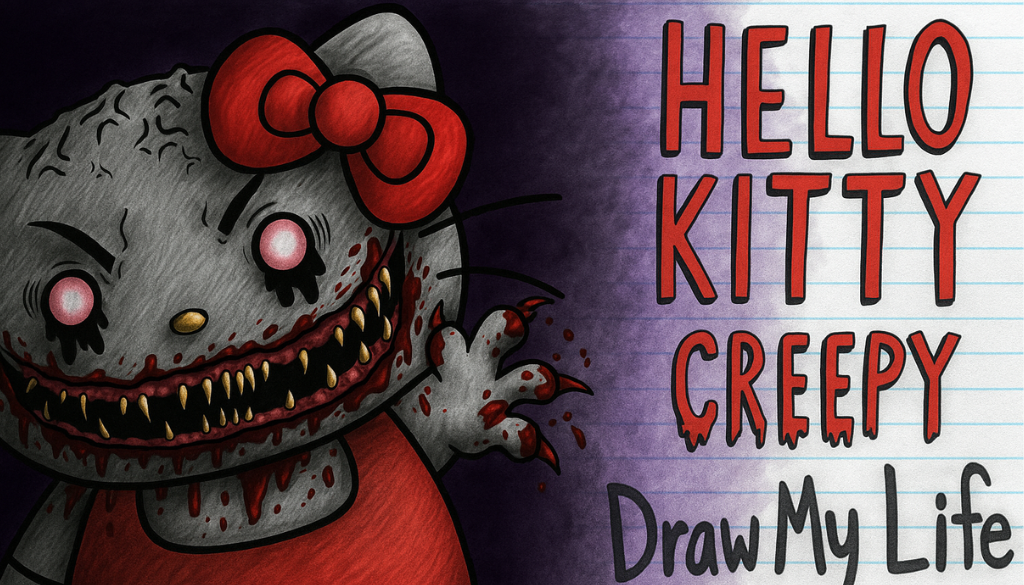
Hello Kitty conjures us memories of wide eyes, pink bows, and adorable, naive charm. Beneath its sweet exterior, however, is a tapestry of hushed stories, startling criminal connections, and whispered legends. This article explores the sinister history of Hello Kitty, looking into its beginnings, dispelling urban legends, analysing links to actual crimes, and considering why such tales persist. We’ll investigate:
- The formal beginning of Sanrio’s and Hello Kitty’s idea
- Common urban legends, such as the notorious “devil pact” story
- The eerie “Hello Kitty murder case” and its lingering consequences
- Why viewers are drawn to the darkness and what can be learned from it
By the conclusion, you’ll have a more realistic and balanced understanding of what is true and what isn’t, as well as why the most sinister tales continue to revolve around an apparently innocuous figure.
Origins: Sanrio to International Star
A Calm Start: Sanrio’s Adorable Approach
When Sanrio was first established in Japan, it made novelty items and accessories. The business started hiring artists in the early 1970s to create “kawaii” (cute) characters to use on merchandise.
Artist Yuko Shimizu created Hello Kitty in 1974, and it made its debut as a vinyl coin purse in 1975. Lewis Carroll’s Through the Looking-Glass served as the inspiration for her name, “Kitty,” and the prefix “hello” alluded to Sanrio’s objective of social contact.
It’s interesting to note that Sanrio positioned Hello Kitty as a small British girl living in London rather than a Japanese cat, an unusual background that enhanced her “stateless” appeal.
Why No Mouth?
Hello Kitty’s lack of a mouth is one of her most well-known design features. According to Sanrio’s official explanation, individuals can project their own emotions onto her because she “speaks from the heart” and doesn’t have a mouth.
Due to her lack of a permanent facial expression, admirers are free to interpret her mood as cheerful, sad, or reflective. Her allure is heightened by this ambiguity.
Myths & Urban Legends: Dark Speculation & The Devil Pact
Despite her innocent corporate beginnings, Hello Kitty is the subject of many urban legends, many of which are extremely macabre or symbolic. Despite being unverified, these myths continue to circulate in dark-theory blogs, rumours, and online forums. Let’s look at the most common ones.
The Myth of the Devil Pact
A contract with the devil led to the creation of Hello Kitty, arguably the most infamous mythology. This myth states that the daughter of a Chinese (or nameless) woman had deadly mouth cancer. In desperation, the mother supposedly called upon Satan, who promised to heal her daughter only if she created a character (Hello Kitty) that would become a global sensation. The mother forfeits something in exchange (the specific terms differ).
According to this belief, the symbolism is linked to the deal since Kitty has no mouth, allegedly because the daughter’s mouth was damaged. According to some mythological incarnations, “Kitty” means “demon” in Chinese, so “Hello Kitty” becomes “hello demon.”
But there isn’t a single reliable source or comment from Sanrio to back up this entire story. It seems to have started as an online rumour that spread through speculative blogs and chain emails.
The Reason It Continues
- Sensationalism: Dark tales garner interest and are more likely to be shared.
- Design ambiguity: A morbid meaning is suggested by the missing mouth.
- Cultural syncretism: Adding exotic fascination by fusing Eastern kawaii culture with Western demon clichés.
It is important to note that there is no solid proof that Hello Kitty was created through any kind of mystical agreement or occult contract.
Disproving Demons and Devils
The devil-pact story is not supported by any company archives or recorded interviews. Sanrio’s statements and published company history consistently point to design and commercial goals rather than superstition. The name “Kitty” is obviously English, and linguistic assertions such as “Kitty means demon” have no basis in standard Chinese or Japanese.
As a result, the dark myth is still a contemporary folktale rather than a reliable historical narrative.
The “Hello Kitty Murder” Case: The True Horror
The Hello Kitty murder case, a horrific crime that occurred in Hong Kong in 1999, is among the most sinister real-life associations with the name “Hello Kitty.” Despite being tangential, it has become part of the legend and makes reference to the name, which stands in stark contrast to the adorable character.
The Offence
Three men and one woman kidnapped Fan Man-yee, a 23-year-old nightclub hostess, in the spring of 1999. She endured days of abuse, rape, and torture before passing away. Her skull was later found inside a Hello Kitty mermaid plush toy that was filled with dead insects after her remains were disfigured.
A lasting horror mythos was produced by the heinousness of this murder and the hideous use of the Hello Kitty doll. Despite Sanrio’s lack of involvement, the contrast between violence and innocence had a terrifying societal impact.
Legal Repercussions and Effects
Due to a lack of evidence, three suspects were found guilty in December 2000 of manslaughter rather than murder. Life sentences with a 20-year parole potential were imposed; one term was later reduced to 18 years. The case is still regarded as one of Hong Kong’s most dramatic criminal cases and gained notoriety throughout East Asia.
The Reason It Hits Home
The public’s terror is heightened by the shocking brutality that collides with a well-known brand. In darker cultural tales, the character’s image was severely altered by the Hello Kitty doll’s use as a vehicle for remains. Even now, references to the “Hello Kitty murder” can occasionally be found in search results and pop culture references, associating the harmless mascot with a terrible real-life crime.
Psychology & Patterns: The Allure of the Dark Side
Let’s examine why Hello Kitty’s sinister backstory is so captivating and what it reveals about human psychology, branding, and mythology.
Cognitive Dissonance and Contrast
Psychological tension is produced by the sharp contrast between sweetness and cryptic terror. Our minds attempt to resolve the contradiction that arises when innocence is linked to scandal.
The Allure of Secret Significance
Interpretation is encouraged by symbols that have unclear or inexplicable design components, such as Kitty’s missing mouth. People create their own narratives when there is no canonical explanation.
In the Age of the Internet, Viral Legends
Online, dark notions are very popular. Dark-story aggregators, forums, and memes reinforce one another, spreading rumours without needing a solid foundation. Retractions rarely gain the same momentum once a myth has gained traction.
Mythology and Branding
Myths about iconic brands are common. Similar to the mythologies created around corporate brands or rock artists, Hello Kitty is the subject of captivating stories that grow, even when they diverge from the truth.
Key Synopsis for Separating Fact from Fiction
| Claim | Reality |
| A diabolical pact produced Hello Kitty in order to save a dying kid. | Lack of reliable proof; based on gossip and chain messaging. |
| “Kitty” signifies “demon” in Chinese. | False; the name is English and has no equivalent meaning in Chinese. |
| Due to the child’s disease, Hello Kitty is mute. | The actual design decision was to make expressiveness unclear. |
| Sanrio is linked to misconduct in the “Hello Kitty murder case.” | No association—criminals used the name, but Sanrio was not one of them. |
| Hi, is Kitty occult or demonic? | Unfounded; no evidence of a connection to occult activities. |
We avoid misrepresenting the gloomy legends while maintaining their core by keeping speculation and verified reality apart.
Risks, Lessons, and Ethical Remarks
The Influence of False Information
The myth of the devil’s agreement demonstrates how easily erroneous yet seductive stories spread. Sensational claims, particularly those involving well-known cultural figures, must be critically evaluated by readers.
Damage to Brands and Reputation
Persistent myths can impact brand perception, particularly among new audiences who are unaware of the true origin, even if Sanrio has never formally addressed all rumour versions.
Ethnocultural Awareness
Numerous Hello Kitty legends use Western, Chinese, or Japanese themes in a variety of hybrid (often inaccurate) ways. When recounting such myths, we must be careful not to stereotype or culturally appropriate them.
Mental Health & Interest in Horror
It may be both fascinating and unsettling to consume dark lore, particularly when it is connected to actual bloodshed. When researching gruesome true crime subjects, exercise caution.
Conclusion & Brief Synopsis
The official origin of Hello Kitty can be traced back to Yuko Shimizu’s 1974 commercial and design decision for Sanrio. A devil contract to save a dying child is the most common dark myth, however it lacks any solid evidence and seems to be contemporary folklore. The Hello Kitty murder case, a notorious incident in Hong Kong in 1999 that involved the disposal of remains in a toy doll, is the true macabre tie.
Contrast, ambiguity, and the need for hidden narratives in popular culture are the reasons behind these gloomy stories’ ongoing popularity. We can appreciate Hello Kitty’s innocent attractiveness as well as the deeper human drives that stories like this reveal if we carefully separate myth from reality.
Ultimately, Hello Kitty’s darkness is more about the interaction of innocence, narrative hunger, and the influence of rumours in the internet age than it is about occult pacts.
FAQs
1. What is Hello Kitty’s sinister backstory?
It alludes to the numerous urban legends, mythologies, and criminal connotations that stand in stark contrast to the character’s adorable persona, including the devil-pact myth and the Hello Kitty murder case.
2. Did the devil really have a hand in the creation of Hello Kitty?
That is not supported by any reliable evidence. The “devil pact” version is a contemporary rumour that has no historical foundation for Sanrio.
3. What is the murder case of Hello Kitty?
A lady named Fan Man-yee was tortured and killed in Hong Kong in 1999; her skull was found inside a Hello Kitty doll. Despite the doll’s misuse, Sanrio was not involved in the crime.
4. Why is there no mouth on Hello Kitty?
Sanrio claims that this design decision was chosen in order to allow people to project their own emotions onto the character, leaving her moods open to interpretation.
5. Does Hello Kitty’s brand currently suffer from any of the negative legends?
Persistent rumours have the power to shape perception among new audiences, even though Sanrio has not accepted the falsehoods. It’s important to comprehend the facts.
6. Do other Sanrio characters have a connection to more sinister themes?
Indeed, Kuromi, a Sanrio character, is frequently viewed as the kawaii world’s darker, more cunning equivalent.