
Introduction
When two people are emotionally linked but never formally define who they are, dating in the modern era can be confusing. Despite having daily communication, emotional sharing, and physical intimacy, this grey area—often referred to as a situationship—lacks definition, commitment, and long-term goals. It’s likely that you are already in one if you have ever wondered, “What are we?” or felt nervous about asking.
Situationships are not always negative. They provide little pressure and freedom to some. Others, particularly those who develop emotional bonds naturally, may find them emotionally taxing and confusing. Fortunately, there are strategies to identify the symptoms early, comprehend your feelings, and determine your next course of action.
You will learn how to tell whether you are in a situationship, how it is different from a relationship, how to recognise certain emotional patterns, and how to proceed—whether that means defining it or ending it.
A Situationship: What Is It?
A romantic or intimate relationship between two persons that lacks formal designations, long-term obligations, or expectations is called a situationship. Although it is not sufficiently defined to be regarded as a complete relationship, it goes beyond friendship.
There might be:
- Closeness on an emotional level
- Closeness on a physical level
- Regular correspondence
- Moments spent together that seem significant
But there is uncertainty regarding:
- What the relationship is
- Where it’s heading
- What each individual desires long-term
People enter situationships for a variety of reasons, such as a fear of being committed, a desire to maintain choices, emotional instability, or just the discomfort of defining the relationship.
Relationship vs. Situationship: Important Distinctions
| Feature | Relationship | Situationship |
| Labels | Well-defined | Uncertain or nonexistent |
| Communication | Honest, stable, and trustworthy | Uncertain or inconsistent |
| Plans for the Future | Discussed and agreed upon | Steered clear of |
| Security of Emotions | Stable and secure commitment | Anxious and uncertain |
| Commitment | Shared and decided | Very little or not defined |
The most significant distinction is mutual clarity. Relationships require deliberate decision-making. Situationships are based on comfort, ease, or a fear of being defined.
The Reasons Behind Situationships
The following factors make situationships prevalent in today’s dating culture:
- Fear of being vulnerable because emotional closeness might be dangerous
- Too many options: dating apps generate countless possibilities
- People who lead busy lives tend to avoid investing emotional time
- Emotional pain from the past: commitment can reopen old wounds
- Temporary friendship—desiring intimacy without commitments
Frequently, one individual feels at ease with the uncertainty, while the other silently hopes it will develop into something tangible.
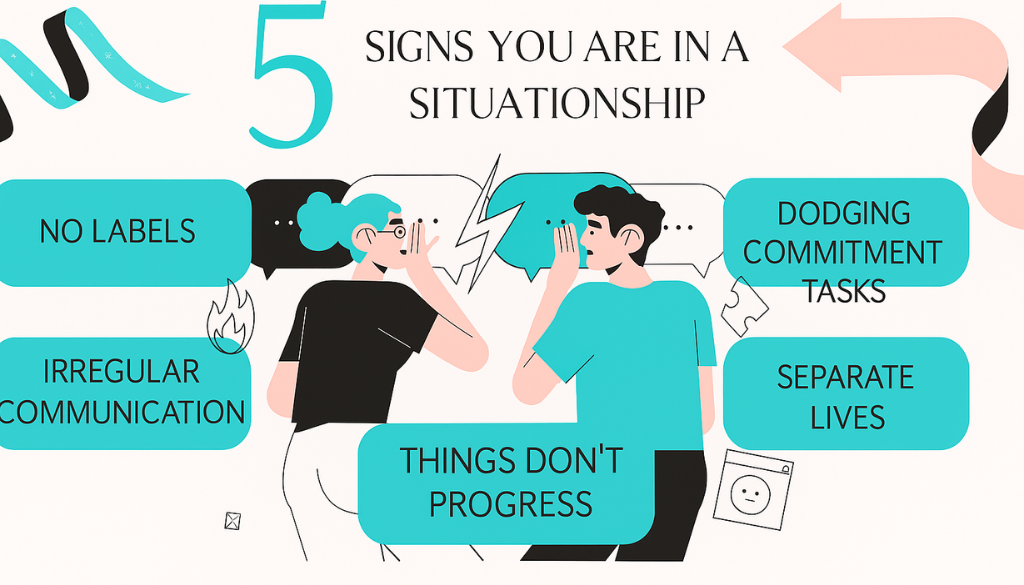
Unmistakable Indications You’re in a Situationship
- No Label Is Present
You refrain from referring to one another as partners, boyfriends, or girlfriends.
It’s a warning indication if the phrase “we’re just seeing where things go” keeps popping up. - Plans Are Informal or Last-Minute
You seldom ever go on scheduled dates. You don’t meet on purpose; you meet when it’s convenient. - There Is Emotional Intimacy, but Boundaries Are Unclear
You don’t discuss future plans or promises, but you do discuss personal experiences. - The Feeling of Hot and Cold Communication
On some days, they are completely there, and on others, they are hazy or distant. - You Steer Clear of the “What Are We?” Discussion
The very notion of bringing it up makes one anxious—fearful of rejection or losing them. - The Relationship Remains Constant
No development, no evolution. Simply repeating. - You Experience More Uncertainty Than Security
Your emotional vitality seems erratic. Do they have the same emotions as me? Do I have unrealistic expectations?
These emotions are indicators, not defects.
Situationships’ Effect on Emotions
Situationships aren’t always unpleasant. However, an imbalance that results from one person becoming more emotionally committed than the other might cause:
- Fear
- Perplexity
- Self-doubt
- Attachment on an emotional level without return
- Having trouble letting go
Your nervous system remains in a condition of waiting when your heart desires clarity but the connection remains unclear, which eventually wears you out.
How to Determine Your Goals
Be clear with yourself before speaking to the other person.
Ask yourself:
- Am I looking for a committed relationship?
- Does this place provide me with emotional support?
- Is this connection reliable or exhausting?
- If nothing changed, would I still be alright?
You require clarification if you answered “no” to question #4.
How to Discuss It: Describe the Relationship Talk
This doesn’t have to be combative or dramatic. Try something like this:
“I cherish our relationship and I prefer to spend time with you. I’d like to know where we think this is going. Something more purposeful is what interests me. How are you feeling?”
Talk from a place of vulnerability rather than pressure.
Things to look out for:
- They already know the answer if they choose not to respond.
- They are not prepared if they show signs of uncertainty.
- There is possibility if people react honestly and cooperatively.
If they desire more, then establish expectations for both parties.
- Talk about communication styles.
- Determine what exclusivity entails.
- Be deliberate rather than assuming.
Clarity and constancy, not just hope, are the foundation of a healthy partnership.
If they don’t want more, they may say things like:
“I like what we have,”
“Let’s just go with the flow,” or
“I’m not ready for a relationship.”
Then have faith in them. Your suffering will only worsen if you continue to hope that they will change. Leaving is not a sign of loss but of self-respect.
Ways to Terminate a Situationship (If Necessary)
- Recognise that your emotions are real.
- Express your choice in a calm and unambiguous manner.
- Refrain from prolonged touch; emotional wounds require separation.
- You are not alone, so rely on friends or assistance.
- Your needs are important, so concentrate on getting back in touch with yourself.
The goal of healing is to rediscover who you are, not to forget them.
How to Proceed
- Respect your requirements to regain your trust.
- Select partnerships where people voluntarily offer clarification.
- Keep in mind that love should feel secure rather than unsure.
- You are worthy of a relationship in which your presence is valued rather than accepted.
In Conclusion
Despite their prevalence, situationships are not inherently innocuous from an emotional standpoint.
You have the ability to choose clarity by defining the connection or by removing yourself from it if you are aware of the warning signs and know what you need.
Your emotions are genuine. Your requirements are important.
Instead of feeling like you’re waiting outside the door, a relationship should feel like home.
A real-life example of how emotions and unclear boundaries can turn complex is the Carly Gregg case. Carly Madison Gregg, a teenager from Brandon, Mississippi, drew national attention in 2024 after being accused of killing her mother and attempting to harm her stepfather. While her story is extreme and tragic, it also highlights how emotional instability, unresolved trauma, and the lack of healthy communication can lead to destructive outcomes. Cases like Carly Gregg’s remind us of the importance of emotional awareness, setting clear boundaries, and seeking help when relationships—romantic or familial—become confusing or toxic.
FAQs
1. What is a situationship, first of all?
A situationship is a romantic relationship that lacks a clear commitment, term, or mutual objectives.
2. What is the ideal duration for a situationship?
It’s time to have a conversation if it hasn’t been defined for more than two to three months and you want clarity.
3. Is it possible for a situationship to develop into a relationship?
Yes, but only after both parties consciously choose to proceed.
4. Why are situationships so painful?
Because security and clarity do not increase with emotional attachment.
5. How do I politely end a situationship?
Set limits, communicate openly, and avoid making contact.